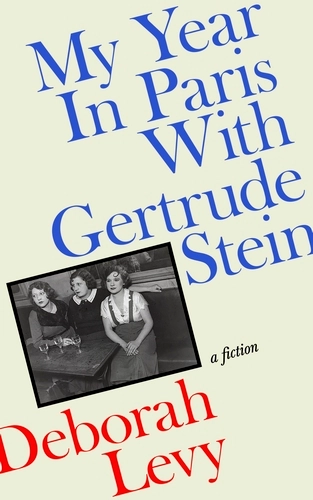
Deborah Levy’s My Year in Paris with Gertrude Stein
My Year in Paris with Gertrude Stein is Deborah Levy at her most formally restless: a novel about a novelist who goes to Paris to write an essay about Gertrude Stein and ends up writing something else entirely. Compressed, witty, allusive — and one of the most rewarding books published this year.
Deborah Levy doesn’t write novels like anyone else. That’s been true since Hot Milk and Swimming Home, both of which were Booker-shortlisted, and it’s especially true of her trilogy of ‘living autobiographies’ (Things I Don’t Want to Know, The Cost of Living, Real Estate), which did something distinctly new with the memoir form by refusing to separate the autobiographical from the invented. Levy’s position in contemporary fiction is unusual: she’s critically celebrated, twice Booker-shortlisted, widely taught, and still somehow underread by the general literary public. My Year in Paris with Gertrude Stein won’t fix the underread problem. It’s too strange for that. But it might be the book that shows, most clearly, what Levy’s been doing all along.
The premise
An unnamed narrator, a writer roughly Levy’s age who shares her documented passion for swimming, goes to Paris to write an essay about Gertrude Stein. The essay doesn’t get written. Instead, she meets two women: Eva, an illustrator in a long-distance marriage whose cat has gone missing, and Fanny, a sexually adventurous financier with a thriving social calendar. Together they cook, walk, argue, search for the cat, and talk about Stein. That’s it. That’s the plot.
If you need more than that from a novel, this isn’t for you. If you’re willing to sit inside a consciousness that’s thinking hard about art, friendship, language, and what it means to live in a city that’s been the backdrop for a century of literary expatriation, it’s one of the most rewarding books published this year.
The novel is set in November 2024, the month of Trump’s re-election, though the political backdrop is handled with Levy’s characteristic lightness. It’s there. She doesn’t labour it. The narrator watches the news on her phone between paragraphs about Stein’s salon and Fanny’s lovers and the missing cat. The world intrudes but doesn’t take over. That balance is one of the novel’s quiet achievements.
What the writing does
Levy’s prose has always worked by compression. Her sentences are short, precise, and slightly off-rhythm. They read like translated work even though they’re written in English, which is a strange compliment but a specific one. There’s a spaciousness to her line that feels borrowed from French or German prose rather than the English tradition. The effect is that you slow down. You read her at a different speed than you read most contemporary fiction. The sentences demand it.
In My Year in Paris with Gertrude Stein, this compression is doing something specific. The narrator is trying to write about Stein, a writer who was herself famous for dismantling language and reassembling it in patterns that baffled her readers. Levy’s prose enacts the difficulty of that project at the sentence level. The narrator keeps circling Stein, approaching from different angles, retreating, trying again. The essay never gets written because the form Levy has chosen, the novel, is already doing the essay’s work.
This is clever without being precious. Levy earns the metafictional layer because the surface is so engaging. Eva and Fanny are vivid, funny, slightly unbelievable characters who ground the philosophical speculation in a world that feels lived-in. Fanny’s sexual adventures are described with the kind of deadpan comic precision that makes you laugh on the bus. Eva’s missing cat becomes a running metaphor for the elusive ‘it’ of Stein’s genius without ever feeling like a symbol being forced into service. The cat is a cat. It’s also more than a cat. Levy holds both simultaneously.
Where the novel sits
The obvious comparison is to Levy’s own living autobiography trilogy. Those books blurred the line between memoir and fiction. This one blurs the line between fiction and criticism. The narrator’s reflections on Stein —her life, her work, her relationship with Alice B. Toklas, her famous salon, her friendship with Picasso and Hemingway —are substantive. You learn real things about Stein from this novel. The historical material is accurate, detailed, and presented with a critic’s attention. But it’s wrapped inside a fiction about three women in contemporary Paris, and the friction between those two layers is where the novel’s energy comes from.
Stein’s refusal to be understood mirrors the narrator’s struggle to write about her. The narrator’s friendships with Eva and Fanny mirror Stein’s legendary capacity for intimacy and argument simultaneously. The novel is constantly in conversation with itself about what it means to know another person through their work.
If I had to place it in a lineage, I’d put it alongside Jenny Offill’s Dept. of Speculation, Anne Carson’s Autobiography of Red, and Chris Kraus’s I Love Dick. All of these are novels that refuse to behave like novels, that use the form as a container for something the form wasn’t designed to hold. Levy belongs in that company and has for a long time.
Where the novel strains
Worth being honest about the moments where the book doesn’t quite hold together. Some of the political observations land with less precision than the literary ones. A line comparing the rise of fascism to pigeons has been noted by more than one reviewer as the kind of quip that sounds smart in conversation and flat on the page. Levy’s instinct for bathos, which usually serves her well, occasionally misfires when the subject is too large for a one-liner.
There’s also a question of accessibility. The novel assumes a reader who knows who Gertrude Stein is, who has at least a passing familiarity with Picasso’s portraits, and who understands why a writer might move to Paris to think about modernism. If you don’t have that context, the novel doesn’t provide much of an on-ramp. It’s not elitist exactly, but it’s written for an audience that already lives inside the literary conversation. Whether that’s a flaw or a feature depends on where you stand.
The narrator’s romantic subplot, a brief encounter with a man met while searching for the cat, fizzles quickly and doesn’t add much. It feels like a concession to the idea that a novel about a woman in Paris should include a love interest, and Levy seems to know it’s a concession because she dispenses with it almost as soon as it arrives.
What it costs to be modern
The book’s real subject isn’t Stein specifically. It’s the cost of invention. Stein spent her career breaking language apart and rebuilding it, and the reward was that her most accessible book (The Autobiography of Alice B. Toklas) was the one she considered a sellout, while her most ambitious work (The Making of Americans) was a commercial failure. The narrator recognises this dynamic because she’s living a version of it. Every writer who’s tried to do something new on the page knows the feeling: the work you’re proudest of is the work fewest people read.
Levy handles this theme with more warmth than self-pity. The novel isn’t a complaint about being misunderstood. It’s a portrait of what it looks like to keep making difficult work when the easier version would sell better. That’s a subject that matters to any writer, and Levy writes about it with the authority of someone who’s spent a career choosing the harder path.
My Year in Paris with Gertrude Stein is a small, dense, intellectually generous book that won’t appeal to everyone and doesn’t try to. It’s Levy at her most Levy: compressed, witty, allusive, formally restless, deeply interested in how women think and live and make art. It’s also the best introduction to her work for a reader who already cares about literary fiction and wants to see what happens when a novelist decides that the boundaries between fiction and criticism are a suggestion rather than a rule. If you’ve read the living autobiography trilogy, this is the logical next step. If you haven’t, start with The Cost of Living and work forward. If you’re a writer yourself, read this book for the sentences alone. They’ll make you want to write shorter.
For more on what contemporary literary fiction is doing in 2026, read Literary Fiction in 2026: What the Best New Books Are Actually Doing. For a related take on expatriate literary life, my essay An Expat in Paris covers similar ground from a different angle. For more on why short, compressed prose is having a moment, see Why Minimalist Fiction Is Harder to Write.
My Year in Paris with Gertrude Stein by Deborah Levy is published by Hamish Hamilton, April 2026. ISBN: 9780241457801. Available from Bookshop.org UK, which supports independent bookshops and contributes a small commission to Tumbleweed Words at no extra cost to you.
If this was useful, buy me a coffee.
Flash fiction and prose poetry in the tradition of what you just read. Written on the road. Over 1,200 readers. Free.
Read and subscribe →