
Tumbleweed Words
One piece of flash fiction or poetry.
Free, every week.
“Everyone wears black so hard you don’t notice
there are differing shades.”
Free · Weekly · No spam · Unsubscribe any time
Men make up roughly twenty per cent of literary fiction readers. An honest look at what happened, what we lost, and one novel I keep giving my male friends.
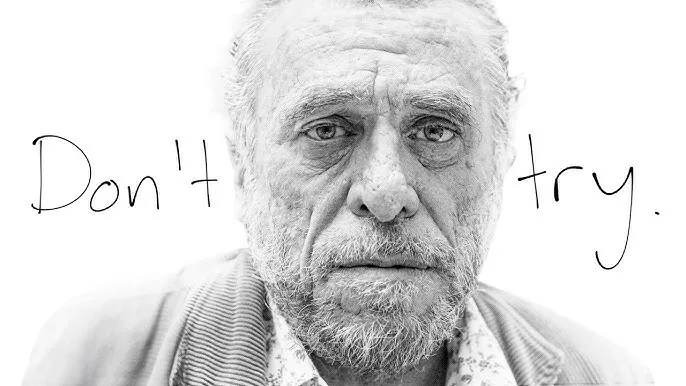
Last Tuesday I gave a copy of Charles Bukowski’s Post Office to a friend at a pub in Leith, Edinburgh.
He’s in his forties. Works in construction. Reads history, mostly. A bit of true crime and the odd slice of biography. Usually the biography is about a footballer or musician. His bookshelf at home has about three hundred books on it. But not one of those books is a novel.
I handed him Bukowski and said, “You’ll love this,” and added that the book was short.
He looked at the cover. Turned it over and read the blurb on the back. Then he said something I have been turning over in my head for the last few days.
“Is it made up?”
I told him yes, it was made up, but also rooted in the joys and struggles of everyday life. Set in the real world among working class people. Then I watched his expression change from one of raised eyebrow curiosity to, shit, my team just conceded a last-minute goal, deflation. He put the book down on the table and ordered another round of lager. Then he changed the subject to something about his missus wanting to turn the garage into a gym. The deflection felt like I’d just asked him about his feelings and he couldn’t begin to express how he felt.
This is a pattern I am seeing among men I know are cultured and curious. Men whose opinions I trust on everything from DIY to personal family matters. They don’t read novels anymore. The good stuff, made-up stuff full of imagination and escapism. And it’s not because they hate reading. They just don’t read fiction, especially literary fiction.
The data backs this up. Women make up roughly eighty per cent of literary fiction readers in the UK and US, depending on which survey you trust. Literary festivals run at about four women to every man in the audience. The average fiction buyer is a woman in her fifties. The figures have not always looked like this. In the 1980s and 90s the split was much closer, around sixty-forty. By 2010 it was seventy-thirty. By 2020 it was eighty-twenty. And the gap is only widening.
The easy version of this conversation goes one of two ways. The reactionary version says men are being quietly erased from literature. Publishers have turned against them and novels directed at men are no longer considered worth being published. The dismissive version says men should read more fiction and it’s their own fault, let them read history books and stew in it. Both ideas miss what is subtly happening.
What happened was boring. It was a slow cultural drift and no one in publishing thought about it or cared enough to address the silent issue. The last generation of novelists who commanded a wide male readership were the writers men read in the 80s and 90s. Updike. Roth. Bellow. Richard Ford. Cormac McCarthy. Martin Amis. Ian McEwan in his early career. Don DeLillo. Jonathan Franzen at the edge. Men read these writers because their fathers read them, because they were in the newspapers their fathers bought, because the books were in the shops they walked past on the way to work.
When those writers retired (do writers even retire?) or died or stopped producing the kind of book their readers wanted, nobody replaced them in the same cultural position. Which of course is hard to do. These are some of the heavy hitters of 20th century fiction. But it wasn’t because the new writers were simply not as strong. There’s plenty of great modern writers: Diaz, Vuong, Haig. The problem was that the infrastructure that used to put those books in front of men quietly disappeared at the same time men’s attention for fiction began to dissipate. And what modern men write about often has little to do with being a “man” in a traditional sense, one that’s slowly been eroded.
The broadsheet newspapers that ran three-thousand-word book reviews on a Saturday morning have cut their book coverage by about seventy per cent since 2005. Many independent bookshops in small towns closed. The literary programmes on Radio 4 got shorter and harder to find. The lad mags that occasionally ran a piece on a new novel are dust. The Sunday supplement your dad used to read over coffee still exists, but the book section is one page and half of it is about celebrity memoirs. Which raises another question: would fiction for men even sell in the world of instant celebrity?
Men in the 80s did not seek out literary fiction. Literary fiction came looking for them because stories and voices had social relevance. When culture shifted, most men stopped reading. Not because they decided to but because they had no idea what to read anymore. There was no place for that kind of fiction in the modern world.
They read, just not novels. I’ve done an informal survey over the last year among friends. I asked them what they read recently. History. Tom Holland, Mary Beard, Dan Jones, Peter Frankopan. Big narrative history with strong male narrators.
Biography, especially military or political. The new Churchill, Napoleon, Thatcher. True crime and unsolved mysteries. David Grann is the crossover king here. Killers of the Flower Moon, The Wager. Men will read literary prose if it is attached to a real story. Stoicism and self-improvement is big. Ryan Holiday, Jordan Peterson, Mark Manson. I’m not going to pretend this is a surprise. Thrillers and spy novels, occasionally. Le Carré holdouts. The new Mick Herron. Robert Harris. Sports memoir, finance, business, popular science. Adam Kay’s medical books. Bill Bryson still sells to men, thankfully.
What is missing from all of those is the thing that literary fiction does. Literary fiction is the only form that spends time inside another human being’s head and shows you what it is like. History tells you what happened. Biography tells you what someone did. Stoicism tells you what to think. Literary fiction is one of the few forms that says: here is what it feels like to be her, him, someone you could likely never become or even know about.
This is the part I keep coming back to. Reading fiction is the place where you spend hours in the head of a woman, a Black American, a Korean grandmother, a Glasgow pensioner, a depressed teenage girl, a dying man. Other art forms do this too, but none of them do it at the scale or depth of the literary novel. Film is shorter. Television is external. Poetry is a snapshot. Only the novel gives you three hundred pages inside another person’s being.
When men stop reading novels, they lose that practice. Not immediately or catastrophically, but over a generation the practice drains out of a culture, and what remains is a population that knows what other people do but not what other people feel. This is not a “men should read more” piece. The question is whether the infrastructure that used to put novels in front of men can be rebuilt, and if so, what that would look like. I do not have a clear answer.
But I keep giving men books. I hand over a short novel, say “this is a good one,” and leave it up to them. About one in four of my male friends read it, about one in eight finishes the thing and then wants to talk about it.
The book I give men more than any other is Charles Bukowski’s Post Office. No spoilers here but if you want to know why, read it and you will. I gave it to my friend in the pub last Tuesday. He put it on the table and ordered another pint and we talked about the football.
The following Saturday morning he sent me a text. It said: “Read it. Twice. Fuck. Give me another book.”
If this landed, buy me a coffee.
Free · Weekly · No spam · Unsubscribe any time
Tumbleweed Words
“Everyone wears black so hard you don’t notice
there are differing shades.”
Free · Weekly · No spam · Unsubscribe any time